

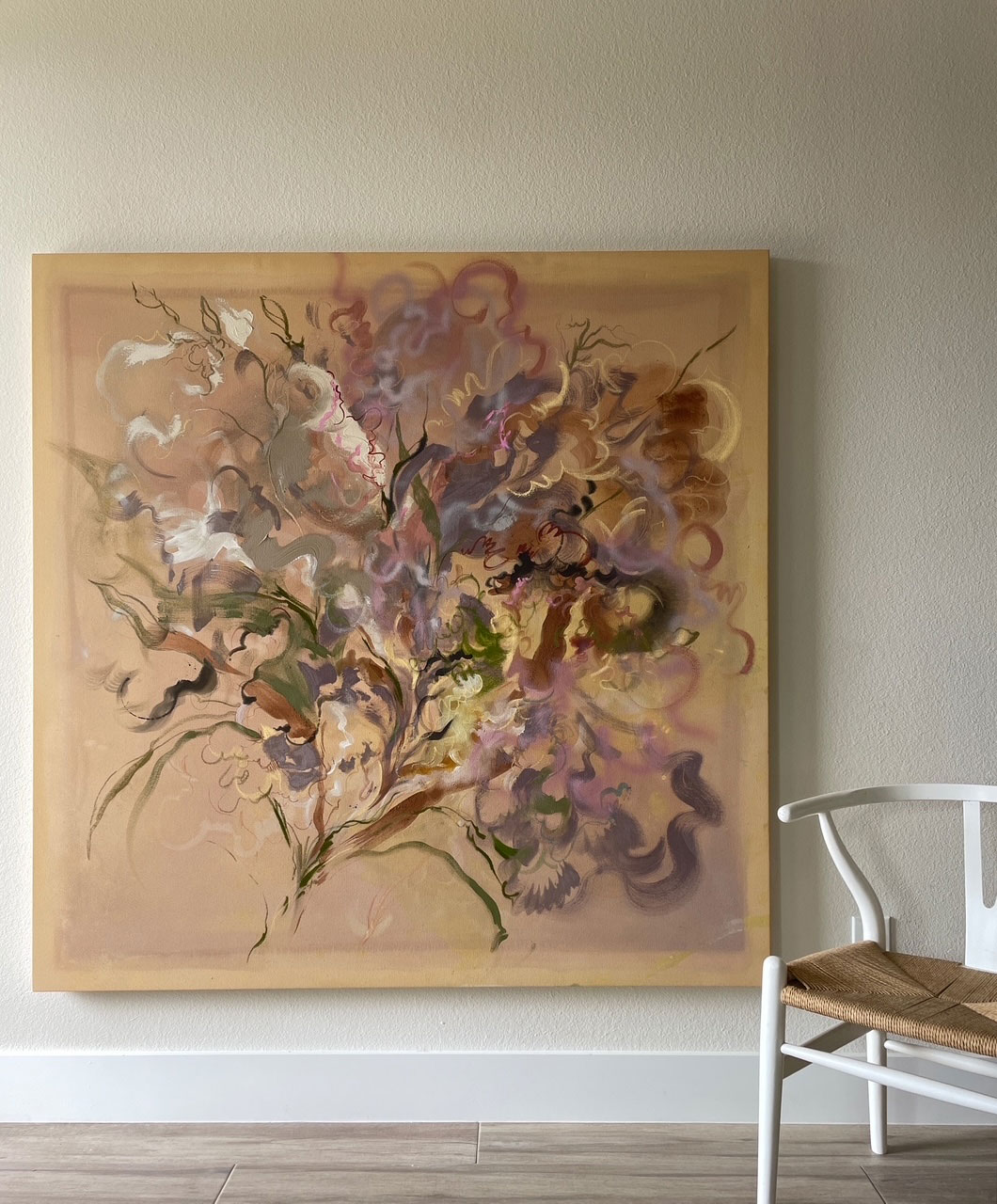
Even in winter’s darkest days, Marcy Vreeland’s Fredericksburg studio is a picture of spring. On a recent visit, scattered vases held periwinkle plumbago and sherbert ranunculus, while on large, stretched canvases and rolls of paper, hollyhocks bloomed amidst plum, violet, and burgundy-colored irises. “I virtually only paint flowers,” said the Amarillo-born artist who grew up in Richardson, the youngest of three daughters.
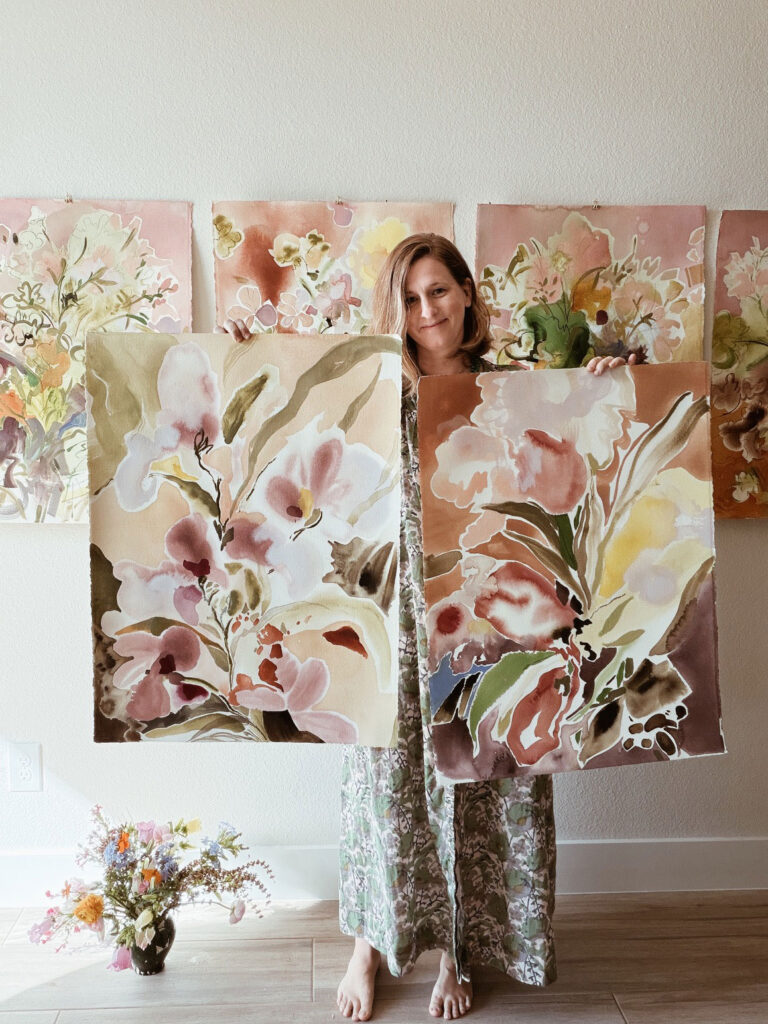
Vreeland discovered her love of visual arts in high school and continued flexing her creative muscles at Baylor University. “It was a super small program, and I loved it,” she shared. “There were only two other students doing painting, so we got very focused attention from our professors.”
Later, while in Rome for a semester abroad, she stumbled upon a small flower shop on her walk to and from class. It was there, between frequent visits with the shop owners, that another proverbial seed was planted, and her passion for floral design began to sprout.
“I knew I didn’t want to jump right into being a professional artist, and I didn’t want to get my masters,” she remembered. With her affinity for color and composition, designing florals felt like a metaphorical extension of painting, and a way to use her education in different ways.
Returning home from Italy, Vreeland got her first internship in the industry, eventually landing a fruitful career post-graduation as a co-owner and florist at Stems of Dallas.
For seven years, she built the company’s portfolio with weddings and corporate events, all while continuing to paint in the margins. By 2017, life’s proverbial winds shifted again, and she shuttered the business to focus fully on her art.
Flowers have been a throughline throughout her professional career, with irises specifically taking center stage in both her early still life collages and abstract paintings. The humble flower, whose name heralds the goddess of the rainbow, is a tantalizing subject matter, each stem and exotic bloom offering its own singular form and nuanced tonality.
Today, the artist’s ongoing fascination with irises is as multi-faceted as the flowers themselves. Once upon a time, Vreeland’s great-great-aunt, Mazie Preston Hall, painted them, and one of her finished canvases hangs in her home as an homage to their shared, generational adoration. It was partly this work, as well as the small patch that flowered outside her home in Dallas years ago, that spurred her to begin painting them for herself.
Fast forward to today, and her house in Fredericksburg has its own iris hedge where she draws endless inspiration come spring. “When they’re in bloom, it is go-time,” she said. “I photograph them and sketch, and I refer to those sketches and photographs all year long.”
Evidence of her ongoing floral fascination can be found throughout her residence, where irises dance from her calming canvases, each petal unfurled with ruffling, undulating texture and warmth. Though the local wildflowers might tempt, it’s the inimitable iris, with its curvaceous contours and otherworldly beauty, that calls her back. “I try to change but I always return to them,” she said of her muse before leaning over as if sharing a secret, “Have you seen the irises outside of St. Mary’s?”
Flora aside, her ethos is indelibly informed by the seasons, and the patterns and cycles that show from winter to spring. More inspirations teem from the long bookshelves inside her sunny studio, with titles reflecting great legends such as Van Gogh and Norman Rockwell. Helen Frankenthaler and Edouard Vuillard are other notable influences, as is the abstract expressionist, Joan Mitchell. Of the latter, she said, “I was obsessively inspired by her in college … She’s very expressionistic, and I love that energy …. I want to be an energetic painter.”
Indeed, Vreeland’s art embodies its own exacting pulse, her brushstrokes alive with emotion and movement. Her creative process begins with an intuitive compositional sketch and involves a medley of tools, be they brushes, rulers, sponges, or her own two hands, all of which bring the depth of her canvases to life. The work is active and ever-changing, and she’s often contributing to upwards of five or six paintings a day, taking breaks before starting again over multiple months. Sound is another instrumental component of her studio environs, be it the music of Gregory Alan Isakov or the soothing narration from an audio book.
Her energy also stems from an ever-evolving experimentation with new tools and techniques. “In 2025, we have access to the most exciting materials and mediums that artists a hundred years ago did not,” she opined. “The art world is interesting – you can push things so far.”
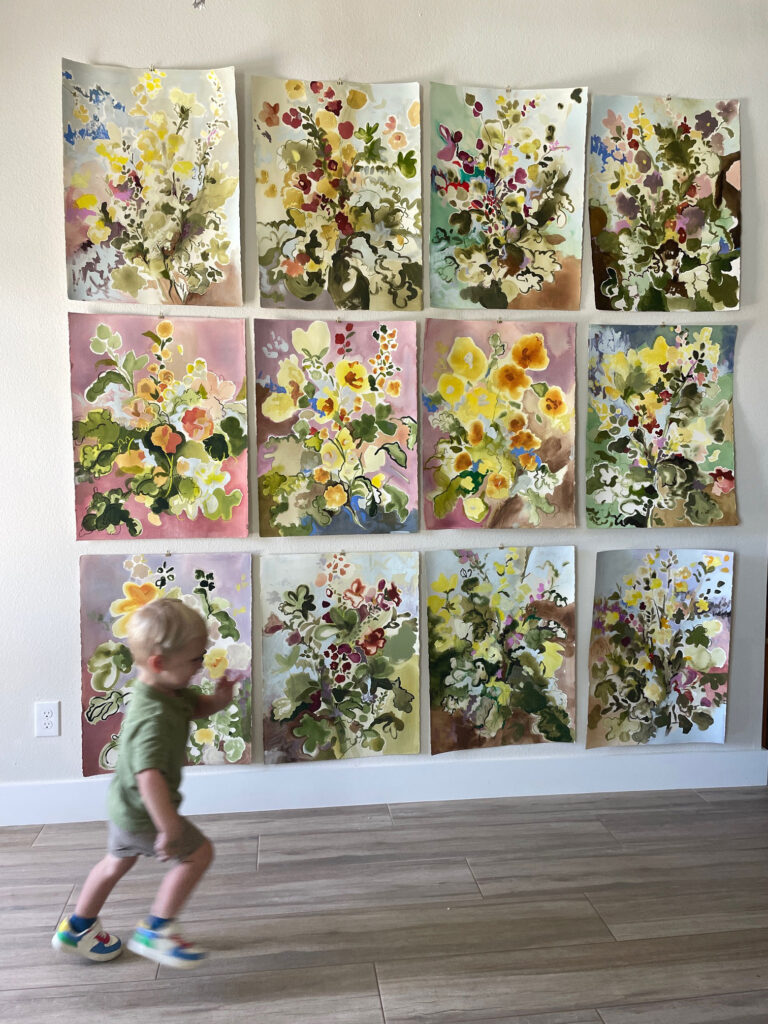
Though she’s allergic to oils, Vreeland finds freedom mixing acrylic with pastels and oil sticks, charcoal pencils, and colored ink washes. For a time, she had spray paint in her arsenal and would spray her fanciful irises with thick orange beards. Recently, she’s been working on both canvas and three-hundred-pound paper while playing with fabric dyes and silks.
Her appetite for challenge is rewarded in her bounty of botanical work, which has undoubtedly been influenced by her 2022 move to Fredericksburg. “It had a huge subconscious impact,” she explained, pointedly. “I feel like the light and colors here and maybe age and motherhood have softened my palette more than anything else.”
Three years ago, leaving Dallas felt like a natural decision for the painter and her husband, a Fredericksburg native, both of whom were working remotely when they migrated south. “We wanted a slower pace of life, and when we got here, we thought, wow – we can breathe,” she said. “There was just less in a good way.”
Today, she is the mother to a son named Teddy and a daughter, Mazie, named after her maternal grandmother, and the great-great-aunt before her whose irises bloom in the Vreelands’ Hill Country home.
Amidst the demands of motherhood, she continues to grow her burgeoning art business. In Fredericksburg alone, she’s brought her handiwork to two local establishments, with painted murals in both Café Dimona and The Albert’s Hotel’s newly revamped restaurant. Farther afield, she’s represented by three galleries in Des Moines, Birmingham and Atlanta, while partaking in her own direct studio sales from time to time.
The latter is a more recent endeavor, and one she hopes will engage her more personally with her growing body of collectors. “I’m trying to figure out how to bring connection and relationship back into the art collecting space,” she said, as she reflected on her dreams and long-term goals. “I love the idea of opening a physical space here too – a studio concept with experiential, community-driven art events – so I’m thinking creatively about that moving forward.”